Essay, November 2026
Why write a coaching philosophy?
Research suggests most coaching philosophies end up as symbols rather than guides. Why I still think writing one is worth it, what should go in it, and how to keep it honest and alive.
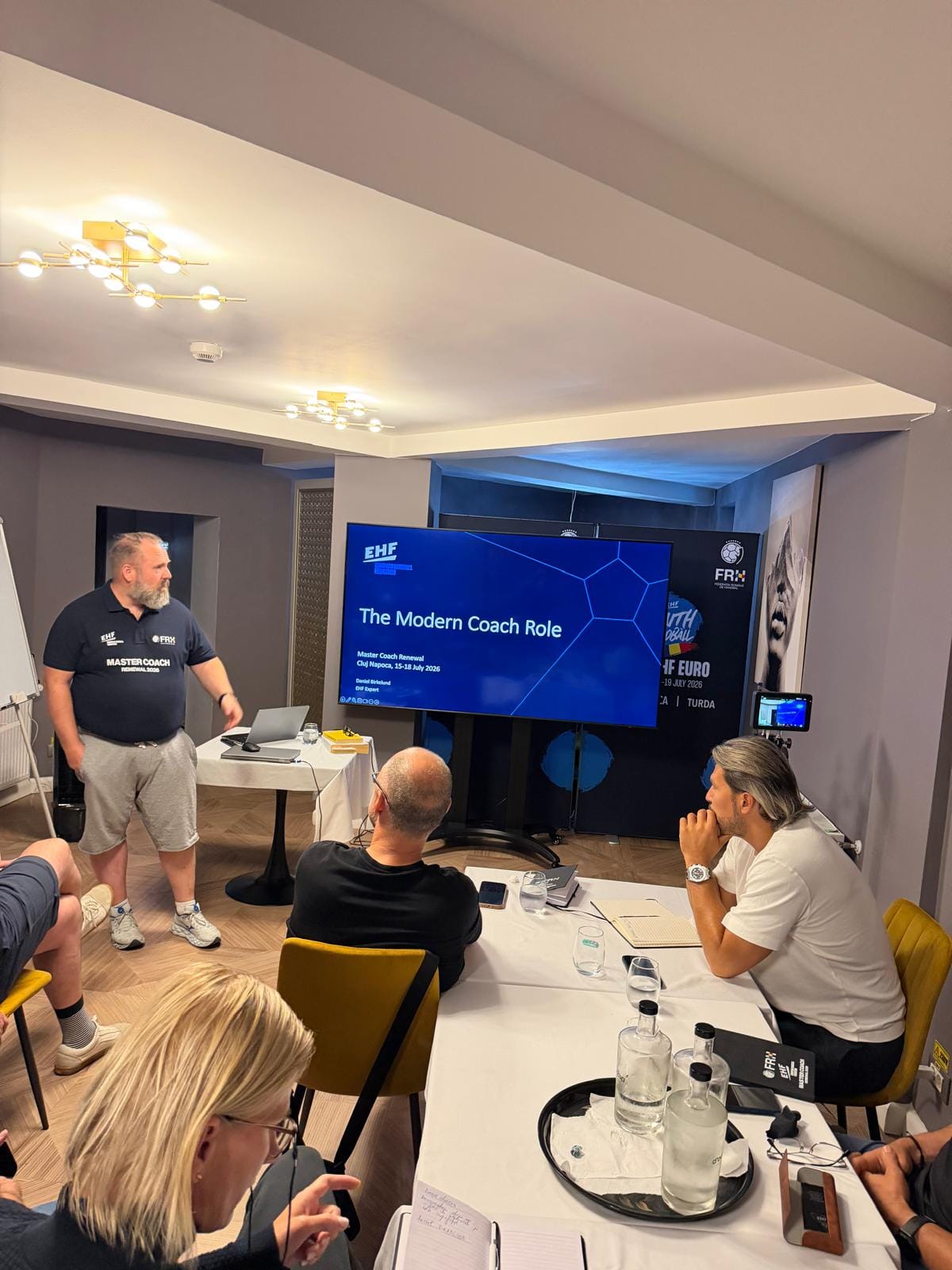
Right now, the coaches on the Norwegian Master Coach course, "Trener 4", are writing their own leadership philosophy. The deadline is 15 December, and the minimum is 4,000 words. When I introduced the assignment in October, I told them that for many of them it would probably be the most daunting task on the whole course. The hardest to get a grip on, at least at the start. But also the most exciting.
I know the feeling. The first time someone asked me to put my philosophy on paper was around 2005, when I took the same course myself (back then it was called "Trener 5"). Since then I have done it again a number of times. Sometimes as part of a course, sometimes in a process with a performance coach or adviser, and sometimes on my own, just because it felt like it was time. The latest round was this autumn. It always gives me something. A slightly deeper understanding of who I am in the role, why I act the way I do, what I believe in and what I don't believe in.
This last time especially helped me get a deeper understanding of some of the projects where I didn't succeed as well as I would have wanted. It was not that the analysis I had already made was wrong. It was more that now I was able to go one, two, maybe even three layers deeper and see myself and my role in both success and failure more clearly.
So I believe in it. Strongly. But only on one condition: it has to be honest. If it is generic and only scratches the surface, it doesn't mean anything.
Why bother?
The strongest case against comes from research. Christopher Cushion and Mark Partington have spent more than a decade taking the concept apart. In a 2016 review they argued that much of what is written about coaching philosophy mixes up rhetoric and ideology with actual philosophy [1]. Then they went and watched. In a later study they followed ten professional coaches in an English football academy for eighteen months. When those coaches talked about their philosophy, they mostly talked about a way of playing: tactical principles, the academy's model player. The word worked more as a symbol than as a guide to anything they did. One coach described himself as empowering his players. The observations showed him controlling the sessions [2].
None of this surprises me. Asked about their philosophy, a lot of coaches will describe how they want their team to play. Others will give you the same words that everyone uses, that are impossible to disagree with and that cost nothing to say: player development, the whole person, putting the player at the centre. There is nothing wrong with those words, if that is who you are and how you actually work. But borrowed words you have never tested against your own practice are not a philosophy. They are a poster on the dressing-room wall.
Cushion and Partington don't stop at the critique. In their latest paper they suggest moving away from the term "coaching philosophy", and looking instead at what actually lies underneath a coach's behaviour, and where it came from [3]. I would keep the word. But the second half is exactly what a good philosophy is for. The problem isn't the idea. It's that most of them are written for someone else to read.
The idea that runs underneath everything on the Norwegian Master Coach course is the reflective practitioner: a coach who can look critically both at the foundation they think they stand on and at what their practice actually looks like [4]. That is why the first written assignment on the course asks the coaches to write down what their own practice rests on. I don't know a better place to start.
What goes in it?
On the course we use a definition I like, from the Norwegian educators Per Lauvås and Gunnar Handal [5]. Your philosophy is your practice theory: the personal mix of knowledge, experience and values that steers what you actually do as a coach and leader. Everyone has one. Most of it is tacit. It is a bit messy, it keeps changing, and it isn't always consistent. Writing it down is the work of bringing it into the light, putting words on it, and then looking at it critically.
Two things follow, and both rule out a lot of what usually gets written.
The first: it is not your handball philosophy. How you want to defend and attack matters, but it answers a different question. A leadership philosophy is about how you lead, how you think people learn, how you communicate, when you decide and when you let others decide, what you do in a conflict. And why.
The second: it has to be connected to what you do. Lauvås and Handal describe this as a triangle. At the bottom is the action: what do I actually do? In the middle are the reasons, from experience and from knowledge: why do I do it? At the top is the ethics: what is right and important for me? A good philosophy moves up and down that triangle, from a concrete situation to the reasons and values behind it, and back down again. A text that only lists values, or only describes your week, doesn't tell you that much.
Where does it show?
Chris Argyris and Donald Schön made a distinction in the 1970s [6] that is still the most useful one I know for this. There is the theory you say you work by, and there is the theory that actually steers what you do. The second one is often invisible to yourself.
The example I gave the coaches: "I want players who make their own decisions." And then, in the timeout, you decide every single action.
The gap tends to show most clearly under pressure. A tight finish. A conflict in the dressing room. Four defeats in a row. Do you still stand on the foundation you say you stand on, or do you become someone else? When things go well, most of us manage to be good versions of ourselves. It is when things crack that a philosophy gets tested.
That gap is not a failure. It is the starting point, and probably the most valuable thing the exercise can show you. It is also why honesty matters more than anything else in the text. If you write down what you would like to be true, there is no gap to find, and the whole thing is wasted.
How do you write one?
Start from situations, not from values. Something that actually happened: a decision you made, a conversation that went wrong, a week where you threw out the plan. What did you do? Why? What does that say about what you believe? The values you find that way are much more likely to be your own than the ones you start with.
Pick a corner. A complete philosophy is a book, not an assignment. It is better to say something interesting about one narrow thing than to scratch the surface of everything.
Write two documents. My full philosophy is long and very personal, and nobody else reads it. That is the point: it can only be fully honest if it isn't written for an audience. From it, I build the documents and presentations that explain my ideas and methods to staff, players and others around the team. I have grown much more aware of that part today than I used to be. The people around me should know who I am and what they can expect.
And if you want to see what my own philosophy looks like right now, or at least the part of it I'm ready to share with the world, you can read Complexity, in plain words, where I describe what I believe in, and How the work gets done, about what it looks like in real life.
Get help, and be careful with it. A performance adviser or a colleague who asks tough questions gives you something you can't get alone. This autumn I did a round with AI, and learned a few things. It is good at taking loose, raw ideas and giving them structure. It is very good at finding inconsistencies and pushing you on them. And sometimes it is easier to be really honest with a machine than with a person, a bit like writing a diary. But it is crap in, crap out. It can't tell you what you believe, and if you let it write your philosophy for you, you end up with a poor text and learn almost nothing from the process. It can also invent sources. So make sure to check everything it gives you.
And do it more than once. Christine Nash and her colleagues found that coaches get better at articulating a coherent philosophy as they gain knowledge and experience [7]. It is a skill, and it improves with use.
And then?
Writing it once and then filing it away is of little use. Mine gets a proper review at least once a year, between seasons, and a quick look now and then during the season. I go back to it when things are hard: when I am trying to turn a negative trend, when I have a difficult decision to make, or when I can't quite work out what is going on.
On Trener 4, the written assignment is followed by "shadowing". The coaches observe each other in three settings: a match (the preparation, the game itself and the evaluation), a training session, and a conversation with a player. That is where the theory you wrote meets the theory you use, because your colleagues see what you actually do, not what you wrote. A lot of the real substance of the course is there.
But what I use my own philosophy for most is as a benchmark. Am I aligned with what I say are my core values? Am I true to what I say is how I work? Or have I let it slide?
And if it has slid, then that opens up really interesting and important questions. Have I made a deliberate choice, because I now believe in something else? Or have I just been caught up in events and ended up slightly off track without realising it?
So changing your mind is not the problem. It should happen. A philosophy is a snapshot of where you are right now, and if the coaches on the course do this exercise again in two years, or in five, their texts will look different. Guaranteed. The problem is the other kind of change... the things that just slid while you were busy with everything else.
That question is the reason I keep coming back to mine. And the reason I keep writing it, again and again.
How this is written: I use AI as a working tool when I write these texts. It helps me with research and fact-checking, and it is part of the writing itself. Sometimes it takes a rough idea of mine, gives it some structure and makes a first draft, and I run with it from there. Other times it gives me feedback on a draft I wrote. Most of the time it is a bit of both, with the text going back and forth until I'm satisfied. And since English is not my first language, it always helps with the final proofreading. The ideas and the opinions are mine.
References
- Cushion, C., & Partington, M. (2016). A critical analysis of the conceptualisation of 'coaching philosophy'. Sport, Education and Society, 21(6). https://doi.org/10.1080/13573322.2014.958817
- Partington, M., & Cushion, C. J. (2024). A deconstruction of coaching philosophy. Sports Coaching Review. https://doi.org/10.1080/21640629.2024.2322838
- Partington, M., & Cushion, C. J. (2025). Re-visiting a critical analysis of 'coaching philosophy': Deconstruction to reconstruction. Sport, Education and Society, 1–14. https://doi.org/10.1080/13573322.2025.2505941
- Schön, D. A. (1983). The reflective practitioner: How professionals think in action. Basic Books.
- Lauvås, P., & Handal, G. (2014). Veiledning og praktisk yrkesteori (3rd ed.). Cappelen Damm Akademisk.
- Argyris, C., & Schön, D. A. (1974). Theory in practice: Increasing professional effectiveness. Jossey-Bass.
- Nash, C., Sproule, J., & Horton, P. (2008). Sport coaches' perceived role frames and philosophies. International Journal of Sports Science & Coaching, 3(4), 539–555. https://doi.org/10.1260/174795408787186495